Proper pallet wrapping ensures that goods arrive at their destination intact and undamaged. When done correctly, it secures the load, protects against environmental factors, and maintains stability throughout the entire supply chain journey.
However, many businesses face persistent pallet wrapping problems that lead to product damage, increased costs, and significant operational inefficiencies. Understanding the most common pallet wrapping problems and how to solve them can transform your packaging operations from a source of stress into a competitive advantage.
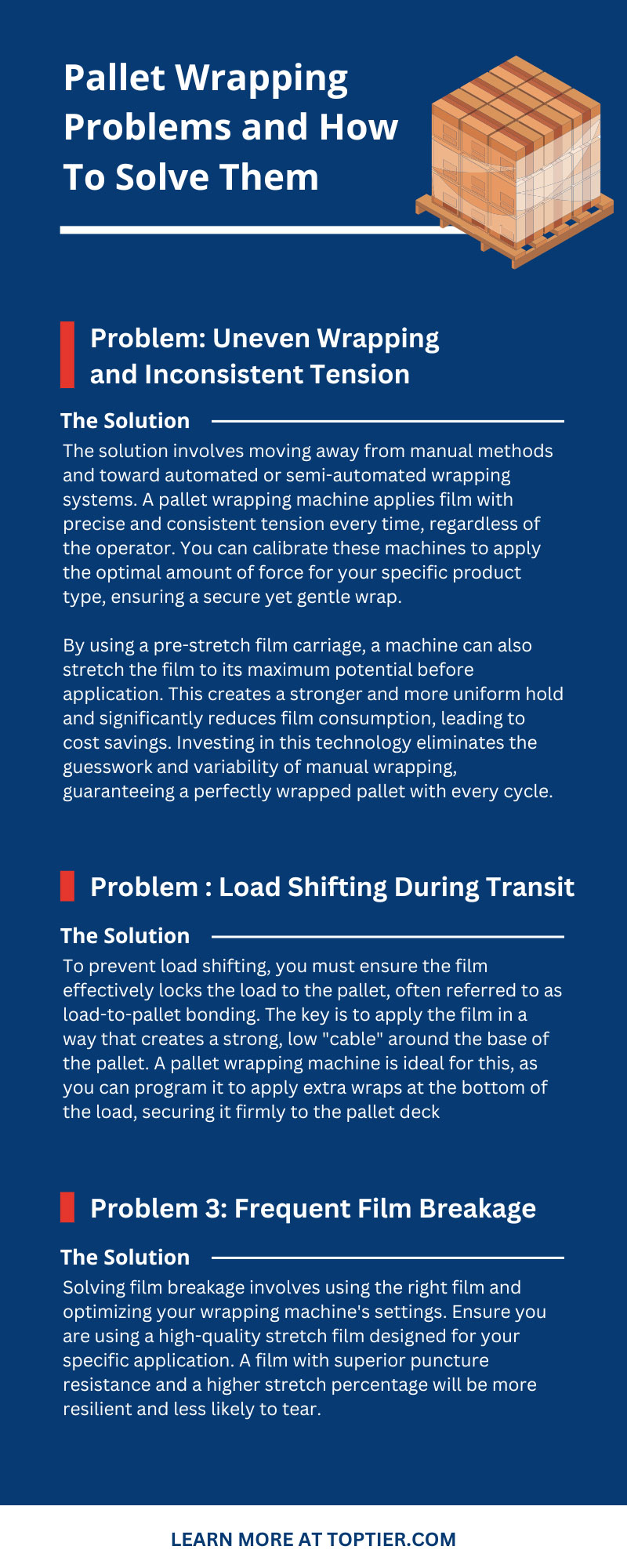
Problem 1: Uneven Wrapping and Inconsistent TensionOne of the most common issues in pallet wrapping is achieving consistent and even tension across the entire load. Applying the stretch film too loosely in some areas and too tightly in others compromises the integrity of the pallet. This often happens with manual hand wrapping, where operator fatigue and varying techniques result in inconsistent application.
Uneven tension can cause parts of the load to become exposed, while overly tight wrapping can crush softer packaging and damage the products within. This leaves the pallet insecure and vulnerable to shifting and damage.
The SolutionThe solution involves moving away from manual methods and toward automated or semi-automated wrapping systems. A pallet wrapping machine applies film with precise and consistent tension every time, regardless of the operator. You can calibrate these machines to apply the optimal amount of force for your specific product type, ensuring a secure yet gentle wrap.
By using a pre-stretch film carriage, a machine can also stretch the film to its maximum potential before application. This creates a stronger and more uniform hold and significantly reduces film consumption, leading to cost savings. Investing in this technology eliminates the guesswork and variability of manual wrapping, guaranteeing a perfectly wrapped pallet with every cycle.
Problem 2: Load Shifting During TransitPallet wrapping creates a single, solid unit that can withstand the rigors of transportation. When a load shifts during transit, it's a clear sign that the wrapping method has failed. Shifting can occur for several reasons, including poor load containment, inadequate film tension, or an incorrect wrapping pattern.
Improperly bonded loads risk toppling over, causing catastrophic product loss and potential safety hazards. This problem is especially prevalent with irregularly shaped or unstable loads, where the contents are more prone to movement.
The SolutionTo prevent load shifting, you must ensure the film effectively locks the load to the pallet, often referred to as load-to-pallet bonding. The key is to apply the film in a way that creates a strong, low "cable" around the base of the pallet. A pallet wrapping machine is ideal for this, as you can program it to apply extra wraps at the bottom of the load, securing it firmly to the pallet deck.
Additionally, using a crosshatch wrapping pattern, where you apply the film in an "X" shape across the load, adds another layer of stability. This technique helps to unitize the entire pallet, preventing individual boxes or items from moving independently. Achieving the right containment force, through the correct number of film layers and tension, is key to keeping your load stable from your facility to its final destination.
Problem 3: Frequent Film BreakageFilm breakage is a frustrating and costly problem that can bring your packaging line to a halt. When the stretch film repeatedly snaps during application, it wastes material, slows down operations, and can be a sign of underlying issues with your equipment or wrapping technique. Film breaks often occur when you stretch the film beyond its capacity or when it catches on a sharp corner of a box or the pallet itself.
Using a low-quality film that lacks the necessary puncture resistance and tensile strength can also be a significant contributing factor. Each break requires the operator to stop, re-thread the film, and start the process over, leading to lost time and productivity.
The SolutionSolving film breakage involves using the right film and optimizing your wrapping machine's settings. Ensure you are using a high-quality stretch film designed for your specific application. A film with superior puncture resistance and a higher stretch percentage will be more resilient and less likely to tear.
You also need to properly adjust the settings on your pallet wrapper. Calibrate the film tension and pre-stretch levels to match the film's specifications. If the tension is too high, it will over-stress the film and cause it to break. Your equipment supplier can help you determine the optimal settings for your film and load type. Regularly inspecting your machine for any sharp edges or misaligned rollers that could be snagging the film is also a crucial maintenance step.
Problem 4: Inefficient Wrapping and High Film CostsMany businesses are surprised to learn how much they are overspending on stretch film. Inefficient wrapping, whether done by hand or with an outdated machine, often leads to excessive material consumption. When operators manually wrap pallets, they tend to use far more film than necessary in an attempt to create a secure load. This drives up costs and creates unnecessary plastic waste.
Similarly, older pallet wrappers that lack pre-stretch capabilities are also highly inefficient.
Without pre-stretch, the system simply wraps the film around the load, failing to utilize its full elasticity and strength. This means you need more layers of film to achieve the same level of containment, resulting in wasted material and higher expenses.
The most effective way to improve wrapping efficiency and reduce film costs is to invest in a modern pallet wrapping machine with a powered pre-stretch system. This technology stretches the film before applying it to the load, often by as much as 250% or more. This means the pre-stretch system applies several feet of film to the pallet for every foot that comes off the roll. This process makes the film stronger and dramatically reduces the amount of film needed to secure a load.
By using less material, you can achieve significant cost savings, often cutting your film consumption by 50% or more. The return on investment for a new machine can be surprisingly fast, with the film savings alone often paying for the equipment in a short period.
Enhance Your Palletizing OperationsProper pallet wrapping is an operational necessity and a strategic advantage. By addressing common pallet wrapping problems and knowing how to solve them, you can protect your products, reduce costs, and improve the overall reliability of your supply chain. The transition from manual or outdated methods to modern, automated pallet wrapping solutions is the most effective way to achieve these benefits. Consistent, secure, and efficient wrapping ensures that your goods arrive safely, maintaining customer satisfaction and protecting your brand's reputation.
At TopTier, we understand that a well-wrapped pallet starts with a well-built pallet. Our range of warehouse palletizer options enhance your entire end-of-line packaging process. By creating stable, uniform, and perfectly stacked loads, our palletizers set the stage for successful wrapping every time. When your palletizing and wrapping systems work in harmony, you create an efficient, reliable, and cost-effective operation. Get a quick quote today to learn more about our palletizers with concurrent stretch wrapping.