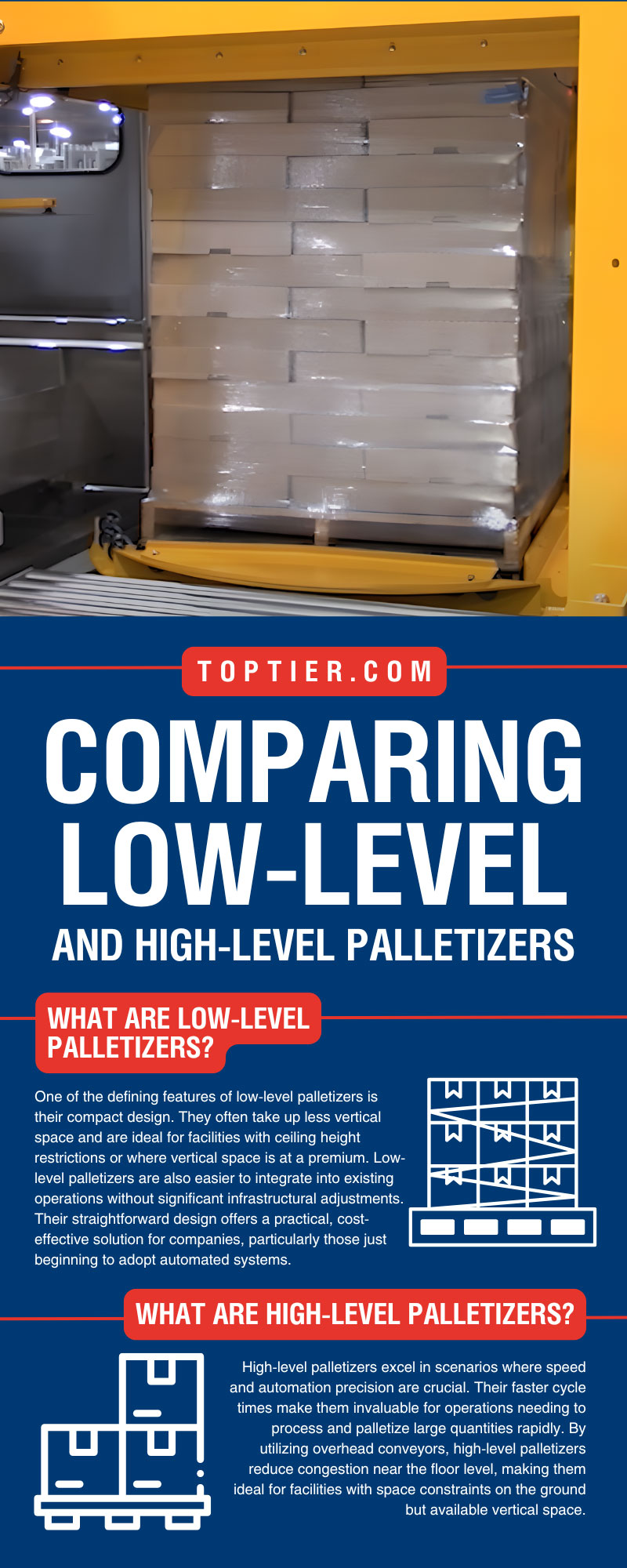
Palletizing is a key process in industries ranging from manufacturing to logistics. It involves arranging products or goods onto pallets for efficient transportation and storage. Without automated palletizing solutions, this process can be time-consuming, labor-intensive, and prone to errors.
This is where palletizers come into play, offering businesses a fast and reliable way to streamline their operations. However, there are different types of palletizers, and two major categories often stand out for comparison: low-level and high-level palletizers. Comparing low-level and high-level palletizers is essential for businesses looking to optimize their workflows and maximize efficiency. Continue reading to determine which type of palletizer is best suited for your specific needs.
What Are Low-Level Palletizers?Low-level palletizers, also known as floor-level palletizers, operate closer to the ground. These machines assemble products into a pallet-ready formation at a relatively low height, typically starting at floor or conveyor level. The palletizing process usually involves product delivery onto a conveyor system that feeds the materials into the machine’s layering mechanism. The system arranges the product layers and builds the entire load directly onto the pallet from the ground up.
One of the defining features of low-level palletizers is their compact design. They often take up less vertical space and are ideal for facilities with ceiling height restrictions or where vertical space is at a premium. Low-level palletizers are also easier to integrate into existing operations without significant infrastructural adjustments. Their straightforward design offers a practical, cost-effective solution for companies, particularly those just beginning to adopt automated systems.
While low-level palletizers are highly functional, they may operate at a slower speed compared to their high-level counterparts. Despite this, they remain a popular choice for many businesses thanks to their reliability, ease of use, and budget-friendly nature.
What Are High-Level Palletizers?Operations that require higher throughput and greater efficiency rely on high-level palletizers. These machines receive products at an elevated height, often via an overhead infeed conveyor. A key difference involves the formation of the pallets. An elevated system feeds products and carefully arranges layers at a higher level before lowering and stacking them onto the waiting pallet below.
High-level palletizers excel in scenarios where speed and automation precision are crucial. Their faster cycle times make them invaluable for operations needing to process and palletize large quantities rapidly. By utilizing overhead conveyors, high-level palletizers reduce congestion near the floor level, making them ideal for facilities with space constraints on the ground but available vertical space.
High-level palletizers typically come with a higher price tag and require more intricate installations. They are also more complex to operate, often needing skilled operators or additional training to ensure smooth functionality.
Key Differences Between Low-Level and High-Level PalletizersThe differences between low-level and high-level palletizers extend beyond their operational height. As such, it’s important to compare low-level and high-level palletizers based on other factors, such as overall productivity, space constraints, and maintenance needs.
SpeedOne of the most notable distinctions is speed. High-level palletizers generally deliver faster performance, making them ideal for industries where efficiency and quick turnaround times are critical. Conversely, low-level palletizers prioritize simplicity and cost-effectiveness, functioning well in settings where throughput requirements are moderate.
SpaceAnother key difference is the space they occupy. High-level palletizers utilize vertical space efficiently, whereas low-level palletizers are better suited to facilities with height restrictions. Installation and integration into existing workflows also vary, with low-level palletizers being simpler and requiring less structural adjustment during setup.
Maintenance and UsabilityFrom a maintenance and usability standpoint, low-level palletizers tend to be more straightforward. Their design is less complex, which often translates to reduced operational downtime and easier troubleshooting. High-level palletizers, while robust and capable of handling higher loads, may require more scheduled maintenance and skilled oversight.
Advantages and Disadvantages of Each Type of PalletizerEach type of palletizer brings unique advantages to the table. However, they also come with trade-offs that businesses need to consider.
Low-Level PalletizersLow-level palletizers are cost-efficient and easy to install and operate, making them a sensible choice for small to medium-sized businesses. Their design is user-friendly, and their installation does not demand significant structural modifications, making them an excellent introduction to automated palletizing.
However, this simplicity comes at the cost of speed. Low-level palletizers are typically slower, making them less suitable for high-volume operations. They may also take up more horizontal floor space since they operate at ground level, potentially causing congestion in tight facilities.
High-Level PalletizersHigh-level palletizers, in contrast, deliver unmatched speed and efficiency. These machines are capable of palletizing larger volumes in less time, which is vital for industries like food and beverage manufacturing or e-commerce fulfillment centers. Their elevated operation frees up floor-level space, reducing ground-level chaos and supporting better workflow management.
Yet, high-level palletizers do come with hurdles. They are often more expensive upfront and have higher operational costs. The complexity of their design requires skilled operators, and businesses may need to invest in employee training to maximize their benefits. Additionally, the installation process can be intricate, often necessitating significant modifications to the facility’s infrastructure and additional lead time before they are fully functional.
Ideal Use Cases for Low-Level and High-Level PalletizersDetermining which palletizer is ideal for your operation often depends on your specific business requirements. Low-level palletizers are particularly well-suited for businesses in industries such as packaging, small-scale manufacturing, and warehouses with moderate throughput needs. They are an excellent option for companies looking to introduce automation to their processes without committing to significant financial or structural changes.
High-level palletizers shine in high-demand environments where efficiency greatly impacts the bottom line. Industries like food and beverage production, pharmaceuticals, and large-scale retail operations benefit immensely from their fast cycle times and ability to handle high volumes with precision. If your operations call for high throughput and you have vertical space to spare, a high-level palletizer could be the perfect solution.
Choosing the Right Palletizer for Your NeedsBoth low-level and high-level palletizers represent powerful solutions for businesses looking to automate and streamline their palletizing processes. A clear understanding of your business’s operational requirements, workflow, and budget will help you make the right decision.
Low-level palletizers offer an approachable, cost-effective entry into automation, making them ideal for businesses with limited space or modest throughput needs. High-level palletizers, while requiring higher investment and more complex integration, deliver unparalleled speed and efficiency for organizations with larger production demands.
The key is to evaluate your specific needs and constraints carefully. Consider factors like volume, available space, infrastructure, and output speed requirements before choosing. With our selection of both high- and low-level palletizers, TopTier’s packaging solutions can significantly optimize your operations and enhance productivity. Contact us today to experience the future of efficient palletizing and transform your workflow.