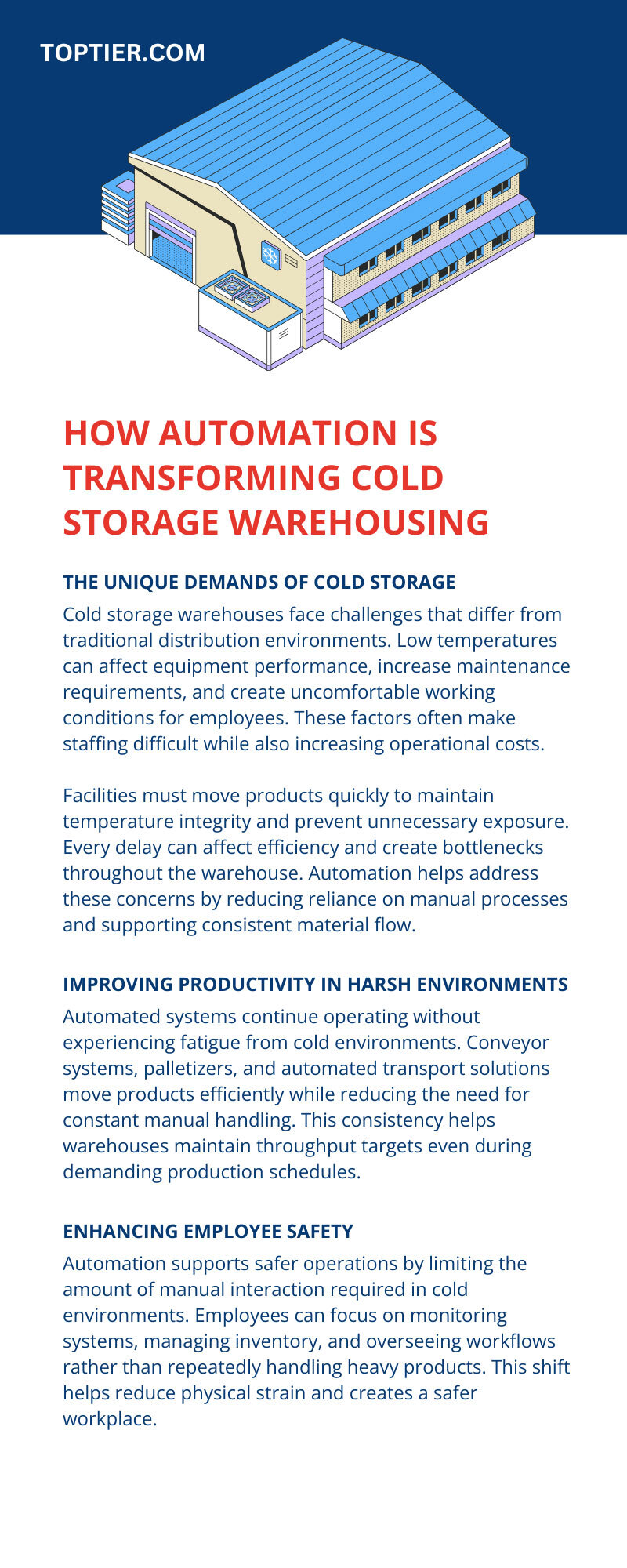
Cold storage facilities operate under demanding conditions that challenge workers, equipment, and productivity. Managing inventory in refrigerated and frozen environments requires dependable material handling processes. As customer expectations continue to rise, warehouse operators seek ways to increase throughput while maintaining product quality and workplace safety. Understanding how automation is transforming cold storage warehousing helps businesses adapt to these demands and create more efficient operations that support long-term growth.
The Unique Demands of Cold StorageCold storage warehouses face challenges that differ from traditional distribution environments. Low temperatures can affect equipment performance, increase maintenance requirements, and create uncomfortable working conditions for employees. These factors often make staffing difficult while also increasing operational costs.
Facilities must move products quickly to maintain temperature integrity and prevent unnecessary exposure. Every delay can affect efficiency and create bottlenecks throughout the warehouse. Automation helps address these concerns by reducing reliance on manual processes and supporting consistent material flow.
Improving Productivity in Harsh EnvironmentsWorkers in refrigerated spaces often require frequent breaks due to environmental conditions. While necessary, these interruptions can reduce productivity and make it harder to maintain consistent output throughout a shift. Automation helps facilities maintain performance regardless of temperature conditions.
Automated systems continue operating without experiencing fatigue from cold environments. Conveyor systems, palletizers, and automated transport solutions move products efficiently while reducing the need for constant manual handling. This consistency helps warehouses maintain throughput targets even during demanding production schedules.
Enhancing Employee SafetySafety remains a major concern in cold storage operations. Slippery surfaces, limited visibility from temperature changes, and repetitive lifting tasks can increase workplace risks. Warehouse managers continually look for opportunities to reduce employee exposure to these hazards.
Automation supports safer operations by limiting the amount of manual interaction required in cold environments. Employees can focus on monitoring systems, managing inventory, and overseeing workflows rather than repeatedly handling heavy products. This shift helps reduce physical strain and creates a safer workplace.
Increasing Inventory AccuracyInventory accuracy plays a critical role in cold storage warehousing. Products often have strict shelf-life requirements that demand precise tracking throughout storage and distribution processes. Manual inventory methods can introduce errors that affect customer service and operational efficiency.
Automated inventory management systems improve visibility across the warehouse. Integrated technologies track product movement in real time and provide accurate data for decision-making. As a result, warehouse operators can maintain better control over inventory while reducing costly mistakes.
Streamlining Material HandlingMaterial handling represents one of the most important functions within a cold storage warehouse. Products must move efficiently between receiving, storage, palletizing, and shipping areas without creating delays. Manual transportation methods can slow operations and increase labor requirements.
Automation streamlines these movements by creating predictable workflows. Automated guided systems, conveyor networks, and palletizing equipment work together to maintain continuous product flow. This coordinated approach helps facilities improve efficiency while reducing unnecessary product handling.
Supporting Labor ChallengesMany warehouse operators struggle to recruit and retain employees willing to work in cold environments. Labor shortages can create operational disruptions and limit a facility's ability to meet customer demand. These challenges continue to push companies toward automation investments.
Automated equipment helps facilities accomplish more work with fewer labor constraints. Rather than replacing employees entirely, automation allows existing teams to focus on higher-value responsibilities. This balance helps businesses remain productive while addressing ongoing workforce challenges.
Improving Energy EfficiencyEnergy consumption represents a significant expense in cold storage operations. Maintaining refrigerated temperatures requires substantial resources, making efficiency improvements especially valuable. Automation contributes to these efforts in several important ways.
Automated workflows reduce unnecessary product movement and shorten handling times. Faster processing helps limit the amount of time doors remain open and reduces temperature fluctuations within the facility. These improvements support more efficient operations while helping warehouses manage energy costs.
Using Data for Better DecisionsAutomation also strengthens decision-making by providing clear operational visibility. Modern warehouse systems collect information from equipment, inventory movements, and production activities throughout the facility. Managers can review performance trends and identify areas that need attention before minor issues become larger problems.
Access to accurate data allows teams to schedule labor more effectively and coordinate shipments with greater confidence. Real-time insights also support faster responses when demand changes unexpectedly. This improved visibility helps cold storage facilities operate with greater consistency while supporting customer expectations.
In addition, automated reporting simplifies compliance documentation and strengthens traceability. Warehouse leaders gain faster access to operational records, making audits easier to manage. Better documentation supports accountability while reducing administrative burdens across daily operations consistently.
Reducing Maintenance DisruptionsCold environments place constant stress on warehouse equipment. Without proper maintenance, unexpected downtime can interrupt workflows and create costly delays. Automation helps facilities manage this challenge through monitoring tools that track equipment performance and highlight developing issues.
Predictive maintenance capabilities allow operators to address wear before a breakdown occurs. Maintenance teams can plan service activities around production schedules rather than reacting to emergencies. This proactive approach supports higher equipment availability and helps warehouses maintain steady operations during busy periods.
The Role of Automated PalletizingPalletizing serves as a critical final step in many cold storage workflows. Warehouse teams must stack products securely and consistently before shipment to maintain stability throughout transportation. Manual palletizing can become difficult in refrigerated environments where speed and accuracy matter.
Automated palletizing systems create uniform loads while maintaining consistent performance throughout the day. These systems handle products with precision and reduce the physical demands placed on employees. The result is improved load quality, greater efficiency, and smoother warehouse operations.
Preparing for Future GrowthCold storage demand continues to evolve as supply chains become more complex and customer expectations increase. Warehouses must position themselves to handle changing requirements without sacrificing efficiency or service quality. Automation provides a practical path toward achieving these goals.
Scalable automated systems allow facilities to expand operations while maintaining control over costs and productivity. Whether supporting higher throughput or adapting to new product requirements, automation helps warehouses remain competitive in a rapidly changing market.
Building More Efficient Cold Storage OperationsThe discussion around how automation is transforming cold storage warehousing continues to gain momentum because the benefits reach every part of the operation. From improved safety and inventory accuracy to stronger productivity and better energy management, automation helps warehouses overcome many of the challenges associated with refrigerated environments. Companies that invest in automated solutions can create more reliable workflows while positioning themselves for future growth.
TopTier supports these efforts with innovative low infeed palletizers designed to improve efficiency and load quality. Our new TTX Series expands those capabilities by providing advanced palletizing performance that helps cold storage facilities streamline operations and maintain consistent results. Learn how the TopTier TTX Series combines proven mechanical design with advanced automation technology.