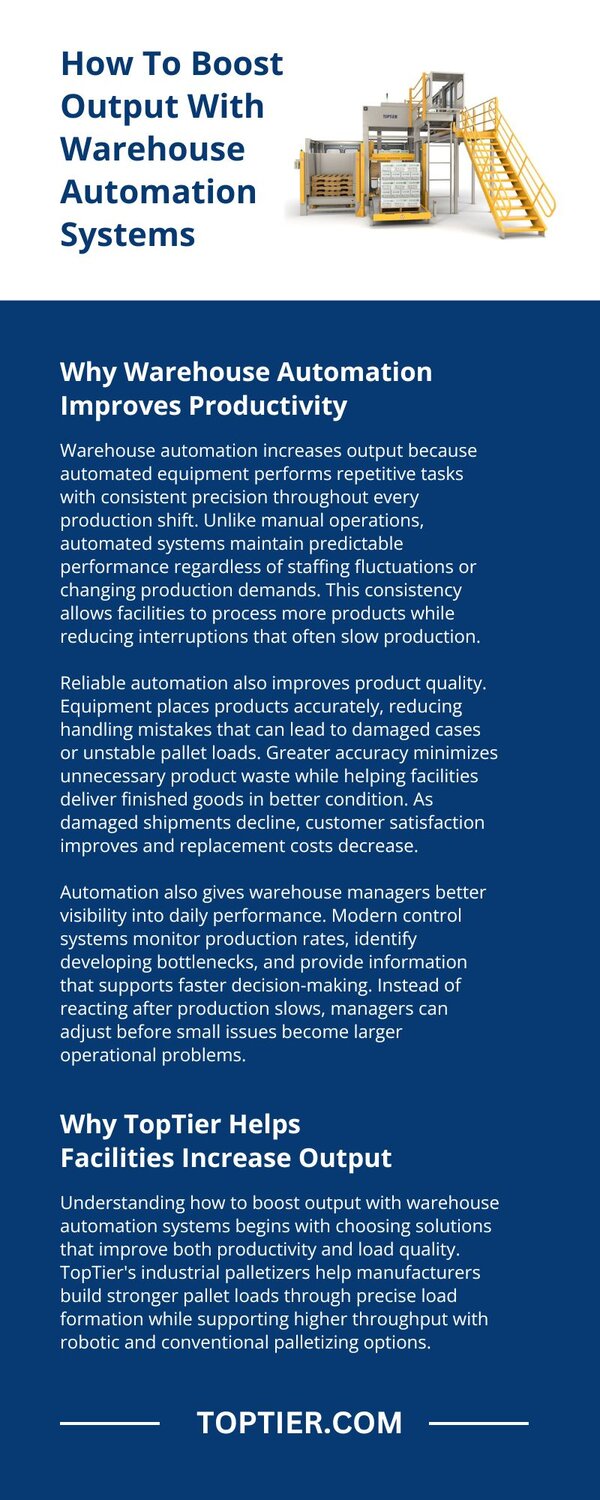
Warehouse operators must increase throughput while maintaining quality and controlling costs. Companies that understand how to boost output with warehouse automation systems can improve productivity by streamlining material flow, reducing unnecessary handling, and increasing consistency. Modern automation supports every stage of warehouse operations, helping facilities maximize throughput without sacrificing accuracy. TopTier enhances these results with advanced palletizing solutions that improve load quality, reduce product waste, and support dependable production schedules.
Why Warehouse Automation Improves ProductivityWarehouse automation increases output because automated equipment performs repetitive tasks with consistent precision throughout every production shift. Unlike manual operations, automated systems maintain predictable performance regardless of staffing fluctuations or changing production demands. This consistency allows facilities to process more products while reducing interruptions that often slow production.
Reliable automation also improves product quality. Equipment places products accurately, reducing handling mistakes that can lead to damaged cases or unstable pallet loads. Greater accuracy minimizes unnecessary product waste while helping facilities deliver finished goods in better condition. As damaged shipments decline, customer satisfaction improves and replacement costs decrease.
Automation also gives warehouse managers better visibility into daily performance. Modern control systems monitor production rates, identify developing bottlenecks, and provide information that supports faster decision-making. Instead of reacting after production slows, managers can adjust before small issues become larger operational problems.
Supporting Long-Term Operational GrowthAutomation creates a foundation for sustainable growth because equipment scales more efficiently than labor-intensive processes. As production increases, automated systems continue operating at consistent speeds without requiring significant staffing increases. Companies can expand production capacity while maintaining predictable operating costs.
Standardized automated workflows also simplify employee training. Operators spend less time performing repetitive manual tasks and more time monitoring system performance, troubleshooting equipment, and supporting continuous improvement initiatives. This shift improves workforce efficiency while helping facilities maintain reliable production through staffing changes.
Eliminating Bottlenecks Across Warehouse OperationsEvery warehouse contains processes that restrict overall productivity. One slow operation can create backups throughout the facility, preventing upstream equipment from reaching its full production potential. Warehouse automation reduces these constraints by creating smooth, continuous product movement between departments.
Improving Material FlowAutomated conveyors, transfer systems, and intelligent controls keep products moving steadily from receiving through shipping. Instead of waiting for manual transportation between workstations, products move automatically through each stage of production with fewer delays. Continuous material flow reduces idle time while allowing equipment to operate more efficiently.
Reducing manual product handling also protects product quality. Every additional touch creates another opportunity for product damage, misplaced inventory, or unnecessary delays. Automation minimizes these risks by moving products through established processes with greater consistency and precision.
Preventing End-of-Line DelaysMany manufacturers improve production speeds only to encounter bottlenecks during palletizing. Manual palletizing frequently struggles to keep pace with faster production lines, forcing upstream equipment to slow or stop until operators catch up. Automated palletizing eliminates this constraint by maintaining production speed while building consistent pallet loads.
TopTier designs palletizing systems that improve load formation accuracy throughout every production cycle. Precise product placement creates stable pallet loads that withstand storage, transportation, and repeated handling without shifting or collapsing. Stronger loads reduce damaged shipments while minimizing product waste and improving overall shipping consistency.
Improving Load Quality Through Better AutomationIncreasing output requires more than producing products quickly. Warehouses must also protect finished goods throughout storage and transportation. Stable pallet loads reduce costly damage while helping customers receive products in excellent condition.
Load Formation Makes a DifferenceAccurate load formation plays a critical role in warehouse efficiency. Even minor placement inconsistencies can weaken pallet stability and increase the likelihood of damaged products during shipment. Automated palletizers position every case precisely, creating uniform loads that distribute weight evenly across the pallet.
TopTier applies years of palletizing experience to develop load patterns that match each customer's products and operating requirements. Rather than relying on standard configurations, the company designs solutions that improve stability while supporting faster production rates. Accurate load formation helps facilities reduce waste, improve consistency, and protect products throughout the supply chain.
Integrating Automation for Maximum EfficiencyWarehouse automation delivers the greatest value when individual systems operate together instead of functioning as separate pieces of equipment. Conveyors, palletizers, warehouse management software, and stretch wrapping equipment should communicate continuously to keep products moving without unnecessary delays. A fully integrated approach reduces manual intervention while allowing facilities to maintain consistent production rates throughout every shift.
Facilities also benefit from faster changeovers when automation systems share production data. Operators can adjust settings quickly as product sizes or packaging requirements change, reducing downtime between production runs. This flexibility allows manufacturers to respond to customer demand without sacrificing throughput or product quality.
Robotic vs. Conventional PalletizingSelecting the right palletizing technology depends on production goals, product characteristics, and operational requirements. Robotic palletizers provide exceptional flexibility for facilities that handle multiple package sizes or frequent product changeovers. Their adaptable design allows manufacturers to introduce new products with minimal disruption while maintaining consistent pallet quality.
Conventional palletizers remain an excellent choice for high-volume production environments that prioritize speed and repeatability. These systems efficiently process large quantities of similar products while producing uniform pallet loads throughout every shift.
TopTier manufactures both robotic and conventional palletizing solutions because every warehouse operates differently. Matching the appropriate technology to each application improves uptime, increases efficiency, and supports long-term operational success.
Using Data To Drive Continuous ImprovementAutomation provides valuable operational data that helps warehouse managers make informed decisions. Production dashboards reveal equipment utilization, production rates, and downtime trends that might otherwise go unnoticed. Instead of relying on assumptions, managers can identify performance issues early and implement improvements before productivity declines.
Production data also strengthens preventive maintenance programs. Monitoring equipment performance allows maintenance teams to schedule service before minor wear develops into costly failures. Planned maintenance reduces unexpected downtime while extending equipment life, helping facilities maintain reliable production throughout the year.
Continuous improvement becomes easier when accurate information guides operational decisions. Small adjustments to material flow, equipment settings, or production scheduling often produce meaningful gains in throughput. These improvements increase consistency while reducing labor inefficiencies and unnecessary operating costs.
Building a More Productive WarehouseSuccessful warehouse automation combines reliable equipment with thoughtful system design. Facilities that optimize material flow, automate repetitive processes, and improve pallet quality create stronger operations capable of supporting long-term growth. Better automation not only increases production but also reduces damaged loads, minimizes product waste, and improves shipping consistency across the entire operation.
Companies that invest strategically also position themselves to respond more effectively to changing customer expectations. Flexible automation allows facilities to accommodate new products, changing order volumes, and evolving distribution requirements without extensive operational disruptions. These advantages help warehouses remain competitive while improving overall profitability.
Why TopTier Helps Facilities Increase OutputUnderstanding how to boost output with warehouse automation systems begins with choosing solutions that improve both productivity and load quality. TopTier's industrial palletizers help manufacturers build stronger pallet loads through precise load formation while supporting higher throughput with robotic and conventional palletizing options.
Our integrated automation expertise, including concurrent stretch wrapping, reduces product waste, minimizes damaged shipments, and improves operational consistency from the production line through final shipment. By delivering dependable performance and scalable automation solutions, TopTier helps manufacturers maximize uptime while preparing their operations for future growth.