Palletizing is one of the most critical yet labor-intensive operations in modern warehousing and manufacturing. The process of stacking products onto pallets for storage and transportation directly impacts operational efficiency, worker safety, and bottom-line profitability. As businesses face rising labor costs and increasing demands for speed and accuracy, the choice between manual and automated palletizing systems has become more consequential than ever.
The decision extends far beyond simple equipment purchases. Companies must weigh immediate labor expenses against long-term operational benefits, consider worker safety implications, and evaluate how their palletizing approach affects overall productivity. Understanding the true labor cost differences between manual and automated palletizing helps business owners make informed decisions that align with their operational goals and financial constraints.
Hidden Costs of Manual PalletizingManual palletizing involves workers physically lifting, moving, and stacking products onto pallets according to predetermined patterns. This traditional approach requires employees to understand proper stacking techniques, maintain consistent pallet quality, and work at speeds that meet production demands.
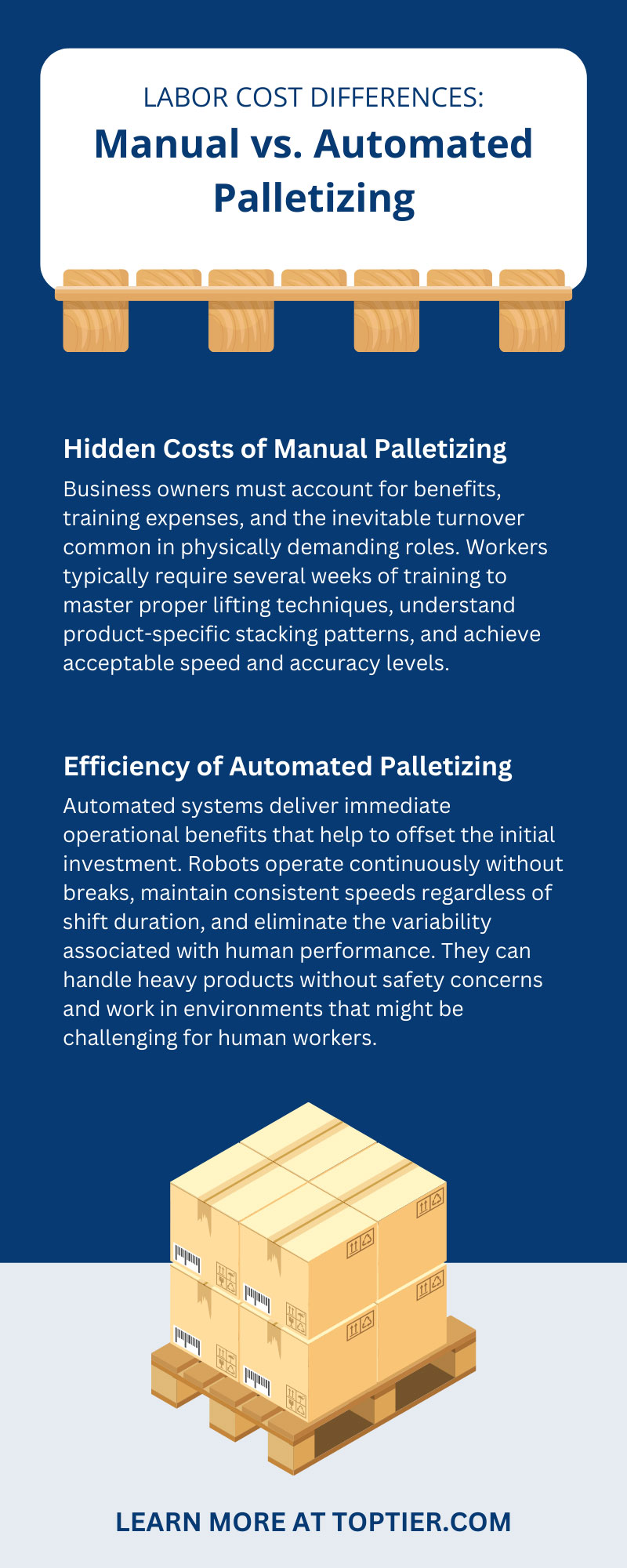
Business owners must account for benefits, training expenses, and the inevitable turnover common in physically demanding roles. Workers typically require several weeks of training to master proper lifting techniques, understand product-specific stacking patterns, and achieve acceptable speed and accuracy levels.
The physical demands of manual palletizing create additional cost factors that many companies initially overlook. Repetitive lifting motions and awkward positioning lead to higher rates of workplace injuries, particularly back strains and musculoskeletal disorders. These injuries result in workers’ compensation claims, temporary staffing needs, and potential OSHA violations that carry financial penalties.
Human error is another significant cost driver in manual operations. Incorrect stacking patterns can lead to damaged products during transport, while inconsistent pallet heights may cause loading difficulties at destination facilities. These errors often require rework, create customer dissatisfaction, and can result in rejected shipments.
Efficiency of Automated PalletizingAutomated palletizing systems use robotic arms, conveyor systems, and sophisticated software to handle the entire palletizing process without direct human intervention. These systems can process various product types, adjust to different pallet patterns, and maintain consistent operation speeds throughout entire shifts.
The initial investment in automated palletizing equipment represents significant capital expenditure. Companies must purchase robotic systems, install supporting infrastructure, and integrate the technology with existing warehouse management systems. This upfront cost often requires careful financial planning.
However, automated systems deliver immediate operational benefits that help to offset the initial investment. Robots operate continuously without breaks, maintain consistent speeds regardless of shift duration, and eliminate the variability associated with human performance. They can handle heavy products without safety concerns and work in environments that might be challenging for human workers.
Long-Term Financial AdvantagesAutomated palletizing systems demonstrate their value through sustained operational improvements over time. These systems typically operate for multiple shifts without requiring rest periods, effectively multiplying production capacity compared to manual operations. The consistency of robotic operations also reduces product damage rates and eliminates the costs associated with rework and customer complaints.
Specialized technicians can predict maintenance costs for automated systems and schedule service during planned downtime. This predictability allows for better budget planning compared to the unpredictable nature of workplace injuries and turnover in manual operations.
Breaking Down the True Cost ComparisonWhen comparing labor cost differences between manual and automated palletizing, several key factors require careful analysis. Labor expenses in manual operations include direct wages, benefits, training costs, and replacement hiring expenses. Companies using manual palletizing typically employ multiple workers per shift to maintain adequate production speeds, multiplying these per-employee costs.
Automated systems require different cost considerations. The initial equipment purchase represents the largest expense, followed by installation and integration. Ongoing expenses include electricity consumption, routine maintenance, and occasional repairs. However, these fees remain relatively stable and predictable compared to the escalating nature of labor expenses.
Productivity and Accuracy MetricsThe speed and accuracy differences between manual and automated systems create significant cost implications. Automated systems typically achieve consistently higher throughput rates while maintaining superior accuracy in pallet construction. This combination reduces labor costs per pallet while simultaneously improving customer satisfaction through consistent product presentation.
Error rates in manual operations can range significantly based on worker experience, shift timing, and product complexity. Automated systems maintain consistent accuracy levels regardless of external factors, reducing the costs associated with damaged products, customer complaints, and rework requirements.
The scalability advantages of automated systems become particularly apparent during peak production periods. While manual operations require additional temporary workers and overtime expenses, automated systems can handle increased volumes without proportional cost increases.
Safety and Regulatory ConsiderationsWorkplace safety is a factor that’s often underestimated in manual palletizing operations. The repetitive nature of lifting and stacking creates ongoing risks for musculoskeletal injuries, which can result in substantial workers’ compensation fees and potential regulatory penalties.
Automated systems eliminate most safety risks associated with manual palletizing operations. This reduction in workplace injuries leads to lower insurance premiums, reduced workers’ compensation claims, and improved compliance with occupational safety regulations. The financial benefits of improved safety records extend beyond direct savings to include enhanced company reputation and easier regulatory compliance.
Choosing the Best Option for Your FacilityThe choice between manual and automated palletizing ultimately depends on individual company circumstances, including production volumes, available capital, and long-term operational goals. Companies with high-volume operations typically find that automated systems provide a faster return on investment through labor savings and improved efficiency.
Smaller operations may find that manual systems remain cost-effective, particularly when production volumes don’t justify the capital investment in automation. However, smaller companies should consider the trajectory of labor expenses and evaluate whether automated solutions might become necessary in the future.
Business owners must evaluate their entire operational strategy, considering factors such as growth projections, labor market conditions, and customer expectations for consistency and quality.
TopTier offers comprehensive palletizing solutions designed to meet diverse operational requirements. Whether your facility needs traditional palletizing equipment or advanced robotic systems, TopTier’s expertise helps companies identify the most cost-effective approach for their specific circumstances. Our range of solutions ensures that you can find palletizing systems that align with your current needs while providing scalability for future growth. Get a quick quote today!