Manufacturers often struggle to add automation without sacrificing valuable production space. Traditional palletizing equipment can occupy significant floor space, leaving limited room for conveyors or future expansion. Compact systems address these challenges by delivering reliable load handling within tighter layouts. Understanding the benefits of small-footprint palletizers helps facility managers identify opportunities to improve operations without major building modifications. These systems support efficient pallet formation while accommodating existing equipment and production demands.
1. Maximize Available Floor SpaceProduction floor space directly influences how efficiently manufacturers organize equipment and move products. Large palletizing systems can restrict traffic flow and limit opportunities to install additional machinery. Small-footprint palletizers reduce these constraints by concentrating automated load building within a compact equipment area.
Facilities can use the recovered space for staging finished goods or improving access around production lines. This flexibility becomes particularly valuable when manufacturers operate in older buildings with limited expansion options.
TopTier offers compact palletizing solutions that help manufacturers automate end-of-line operations without unnecessarily expanding equipment footprints. Our palletizing equipment supports facilities seeking practical alternatives to space-intensive material handling arrangements.
2. Improve Production Line IntegrationEnd-of-line automation must work alongside existing conveyors and upstream packaging equipment. Compact palletizers simplify integration by reducing the physical area required for automated load formation.
Manufacturers can position equipment closer to case handling operations, potentially reducing conveyor lengths and unnecessary product transfers. Shorter transfer paths can also simplify troubleshooting when cases encounter alignment problems.
TopTier designs palletizing systems around production requirements and facility layouts. Our experience with conventional palletizers helps manufacturers evaluate equipment placement while maintaining reliable product flow.
Accommodate Existing InfrastructureMany facilities cannot relocate structural columns or completely redesign their production areas. Compact equipment provides additional installation flexibility when these limitations affect available space.
Careful layout planning still matters. Engineers must account for maintenance access and safe operating clearances before finalizing equipment placement.
3. Reduce Manual Material HandlingManual palletizing requires employees to repeatedly lift cases and position products into stable loads. These repetitive movements can create ergonomic concerns, particularly when production volumes increase.
Small-footprint palletizers automate repetitive stacking tasks without requiring extensive floor space. Operators can focus on monitoring equipment performance rather than continuously handling finished cases.
Automation also supports consistent case placement throughout production shifts. Reliable stacking patterns help manufacturers reduce handling errors that could compromise pallet stability.
4. Support Consistent Pallet FormationLoad consistency affects product protection throughout storage and transportation. Uneven layers or poorly aligned cases can create unstable pallets that shift during handling.
Compact palletizers use controlled stacking sequences to position products according to established pallet patterns. This repeatability helps maintain uniform loads across extended production runs.
TopTier's conventional palletizing technology supports accurate load formation for applications involving packaged consumer goods. Manufacturers can evaluate product dimensions and stacking requirements to determine appropriate equipment configurations.
Improve Load StabilityConsistent pallet patterns distribute product weight more predictably across the load. Proper case positioning also supports effective stretch wrapping. When manufacturers combine accurate stacking with appropriate load containment, they can reduce damaged products and avoid unnecessary rework.
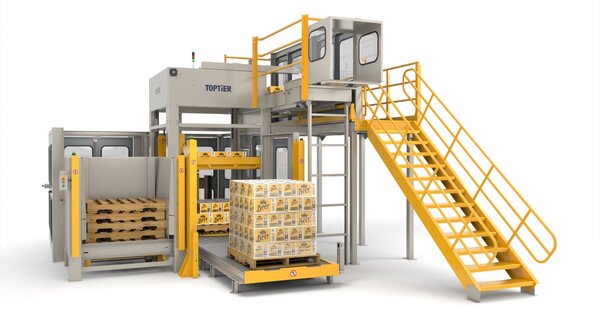
A compact equipment arrangement can make production areas easier to manage. Operators spend less time navigating around oversized machinery when equipment fits naturally within the existing layout.
Small-footprint palletizers also support centralized monitoring of automated stacking activities. Clear access to controls allows employees to identify operating conditions and respond to interruptions.
Facilities should evaluate these operational advantages alongside equipment capacity and maintenance requirements. A compact machine must still deliver the throughput necessary to support upstream production.
6. Increase Flexibility for Different ApplicationsManufacturers frequently handle multiple package sizes or change production requirements over time. Compact palletizing systems can provide flexibility when facilities select equipment that accommodates their product range.
Important considerations include:
- Case dimensions: Confirm equipment compatibility with product sizes.
- Production speed: Match palletizing capacity to line output.
- Pallet patterns: Evaluate stacking arrangements for load stability.
- Available clearance: Allow adequate room for operation and maintenance.
- Future requirements: Consider anticipated packaging changes and production growth.
These factors help manufacturers select compact equipment without compromising application performance.
7. Integrate Palletizing and Stretch WrappingSeparate palletizing and wrapping stations can increase the space required for end-of-line operations. Manufacturers must also accommodate conveyors that transfer completed loads between machines.
TopTier addresses this challenge through its concurrent stretch wrapping technology. The system applies stretch film during pallet formation rather than waiting until operators complete the entire load.
This integrated approach can reduce additional handling steps and help maintain load stability throughout the stacking process. It also supports consistent film application while minimizing unnecessary equipment transfers.
Reduce Product DamageWrapping loads during formation helps secure products before they move through downstream operations. This approach can benefit applications involving cases that require additional stabilization. Manufacturers should consider product characteristics and shipping conditions when determining suitable containment methods.
8. Accommodate Upper-Level PalletizingUpper-level palletizers offer another option for manufacturers seeking compact automation. These systems receive products at an elevated infeed position, allowing facilities to take advantage of existing overhead conveyor arrangements.
TopTier offers upper-level palletizers that support efficient case handling while helping manufacturers manage floor space limitations. This configuration can work particularly well in facilities where upstream equipment already delivers products at elevated heights.
Equipment selection depends on production flow and building requirements. Manufacturers must evaluate ceiling clearance and service access to determine whether an upper-level arrangement suits their operations.
9. Support Long-Term Operational EfficiencyCompact palletizing equipment can help manufacturers improve space utilization without relocating entire production lines. This advantage becomes increasingly important as facilities introduce additional packaging equipment.
TopTier's experience with end-of-line automation helps manufacturers assess compact configurations against their operational needs. Appropriate equipment selection can support dependable performance while preserving flexibility for future production changes.
Choose Compact Palletizing Solutions From TopTierUnderstanding the benefits of small-footprint palletizers allows manufacturers to make informed decisions about automation investments. Compact systems offer practical advantages for facilities balancing limited space with demanding production requirements.
TopTier manufactures palletizing equipment designed to address these challenges, including upper-level palletizers and systems with concurrent stretch wrapping. Our solutions help manufacturers improve load consistency while making better use of available production space. Contact TopTier to discuss palletizing solutions that fit your facility's layout and production goals.