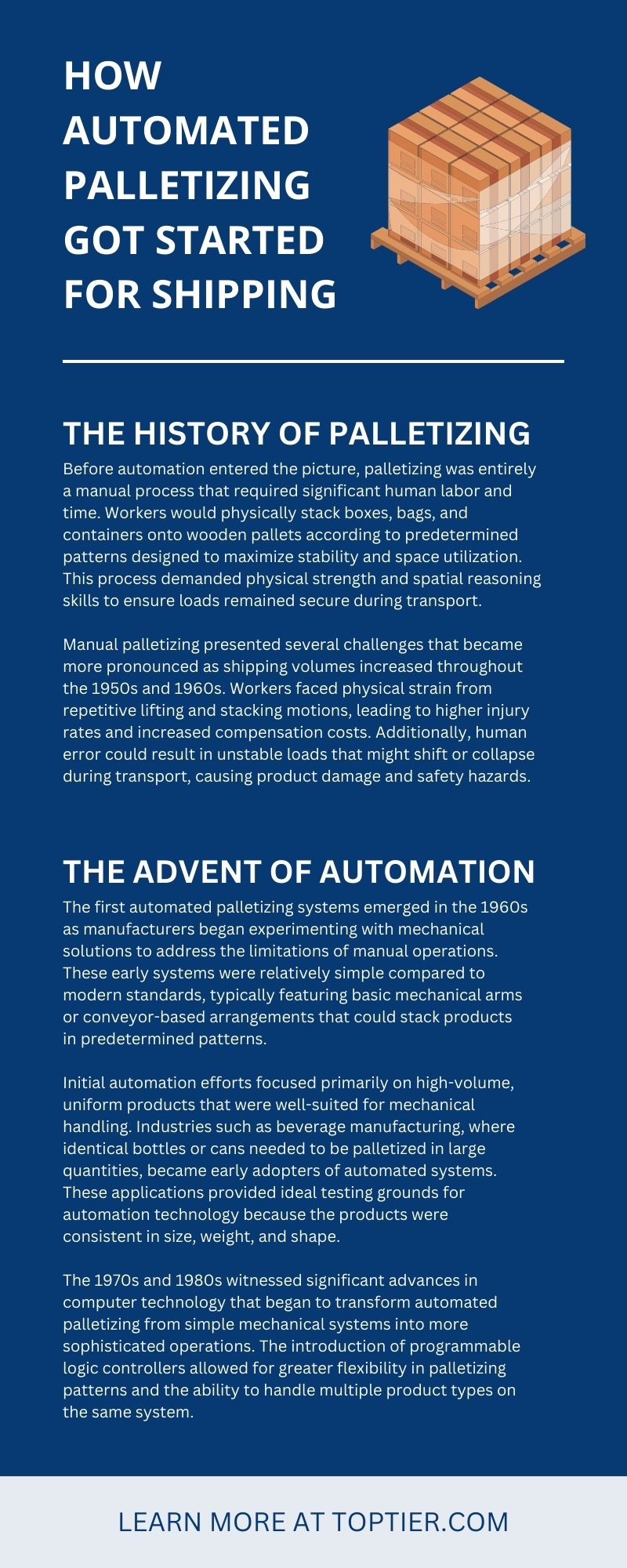
Over the past century, the shipping industry has seen many advancements, but few have been as transformative as automated palletizing. Automated palletizing has become a cornerstone of modern logistics by allowing companies to manage massive volumes of products with unparalleled speed and accuracy. Tracing its evolution—from manual labor to cutting-edge robotics—highlights the ingenuity of industrial engineering and underscores the relentless pursuit of efficiency driving global commerce.
The history of how automated palletizing got started for shipping offers a fascinating glimpse into the ways technology continually reshapes logistics processes around the world.
The History of PalletizingBefore automation entered the picture, palletizing was entirely a manual process that required significant human labor and time. Workers would physically stack boxes, bags, and containers onto wooden pallets according to predetermined patterns designed to maximize stability and space utilization. This process demanded physical strength and spatial reasoning skills to ensure loads remained secure during transport.
The concept of palletizing itself emerged during World War II when the US military needed efficient ways to transport supplies across vast distances. The standardization of pallet sizes and the development of forklift trucks created a foundation for what would eventually become modern warehouse operations. However, the manual nature of early palletizing meant that worker endurance and the inherent variability in human performance limited operations.
Manual palletizing presented several challenges that became more pronounced as shipping volumes increased throughout the 1950s and 1960s. Workers faced physical strain from repetitive lifting and stacking motions, leading to higher injury rates and increased compensation costs. Additionally, human error could result in unstable loads that might shift or collapse during transport, causing product damage and safety hazards.
The limitations of manual systems became particularly apparent during peak shipping seasons when demand surged beyond what human workers could reasonably handle. Companies found themselves struggling to meet delivery deadlines while maintaining quality standards, creating pressure to explore alternative solutions.
The Advent of AutomationThe first automated palletizing systems emerged in the 1960s as manufacturers began experimenting with mechanical solutions to address the limitations of manual operations. These early systems were relatively simple compared to modern standards, typically featuring basic mechanical arms or conveyor-based arrangements that could stack products in predetermined patterns.
Initial automation efforts focused primarily on high-volume, uniform products that were well-suited for mechanical handling. Industries such as beverage manufacturing, where identical bottles or cans needed to be palletized in large quantities, became early adopters of automated systems. These applications provided ideal testing grounds for automation technology because the products were consistent in size, weight, and shape.
The 1970s and 1980s witnessed significant advances in computer technology that began to transform automated palletizing from simple mechanical systems into more sophisticated operations. The introduction of programmable logic controllers allowed for greater flexibility in palletizing patterns and the ability to handle multiple product types on the same system.
During this period, robotic technology also began to influence palletizing automation. Industrial robots, initially developed for automotive manufacturing, were adapted for material handling applications. These robotic palletizers offered greater flexibility than fixed mechanical systems, capable of adjusting to different product sizes and stacking patterns through reprogramming rather than physical reconfiguration.
Benefits of Automated PalletizingThe transition to automated palletizing brought numerous advantages that extended far beyond simple labor cost reduction.
SpeedSpeed emerged as one of the most significant benefits, with automated systems capable of palletizing products at rates that far exceeded human capabilities. Where manual operations might stack several hundred cases per hour, automated systems could handle thousands of units in the same timeframe.
ConsistencyConsistency represented another crucial advantage of automation. Automated systems follow precise programming to create uniform, stable loads every time, eliminating the variability inherent in human performance. This consistency translates directly into reduced product damage during transport and storage, as palletized loads maintain their integrity more reliably.
SafetySafety improvements accompanied the implementation of automated palletizing systems. By removing human workers from repetitive lifting tasks, companies significantly reduced workplace injuries related to material handling. The automation of heavy lifting and stacking operations created safer work environments while allowing human employees to focus on higher-value tasks requiring problem-solving skills and decision-making abilities.
CostCost effectiveness became increasingly apparent as automated systems matured. While initial capital investments were substantial, the long-term operational savings through reduced labor costs, decreased product damage, and improved efficiency created favorable returns on investment. Additionally, automated systems could operate continuously without breaks, maximizing facility utilization and throughput.
Challenges and SolutionsThe implementation of automated palletizing systems for shipping was not without obstacles.
Technical IssuesEarly adopters faced significant technical challenges as technology was still developing and lacked the reliability that modern systems provide. Equipment breakdowns could halt entire production lines, and the specialized knowledge required for maintenance and troubleshooting was not widely available.
IntegrationIntegration with existing warehouse management systems posed another hurdle. Automated palletizing equipment needed to communicate effectively with inventory management software, conveyor systems, and other warehouse automation components. Developing these interfaces required careful coordination between equipment manufacturers and software developers.
Diverse Product LinesThe variety of product types and packaging formats in many industries created complexity for automated systems designed around uniform products. Companies handling diverse product lines needed more sophisticated equipment capable of adapting to different sizes, weights, and stacking requirements. This flexibility came with higher costs and increased system complexity.
Workplace AdaptationImplementing automated palletizing systems required retraining employees and sometimes led to job displacement concerns. Successful implementations typically involved comprehensive change management programs that helped workers transition to new roles while addressing concerns about job security.
The Modern Era of Automated PalletizingAutomated palletizing has evolved from a novel concept to an essential component of modern shipping and logistics operations. Advanced robotic systems now incorporate artificial intelligence and machine learning capabilities that enable them to handle increasingly complex tasks and adapt to new products with minimal reprogramming.
The integration of automated palletizing with broader warehouse automation ecosystems has created seamless operations where products flow from production lines through palletizing systems to automated storage and retrieval systems. This level of integration represents the culmination of decades of technological development and operational refinement.
As ecommerce continues to drive demand for faster, more efficient shipping, automated palletizing systems will undoubtedly continue evolving. The foundation laid by early automation pioneers has created an industry infrastructure capable of handling the massive volumes of goods that define modern global commerce.
If you’re interested in innovating your shipping strategy, check out TopTier’s robotic palletizer cells to increase throughput and reduce cycle times for high-speed processes. Browse our selection to enhance efficiency and elevate your material handling operations today.