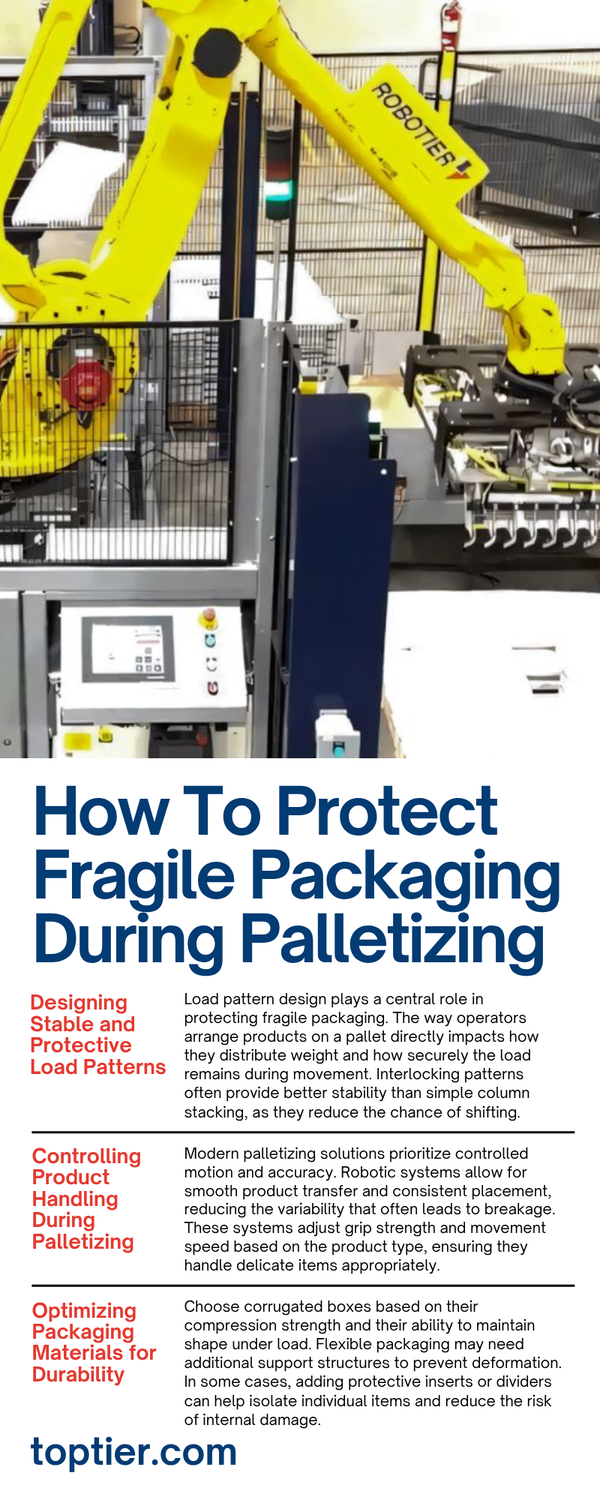
Protecting fragile products during palletizing is one of the most critical challenges in modern packaging operations. From glass containers to lightweight cartons and flexible packaging, even minor instability can lead to product damage, waste, and costly downtime. Understanding how to protect fragile packaging during palletizing requires a combination of proper load design, equipment selection, and process control. When executed correctly, palletizing preserves product integrity and improves efficiency and consistency across the entire operation.
Understanding the Risks of Fragile PackagingFragile packaging fails when it experiences excessive pressure, shifting, or impact during stacking and transport. These risks often originate during the palletizing stage, where operators repeatedly handle products and stack them at high speeds. If alignment is off or operators apply force unevenly, even well-designed packaging can collapse or deform.
Operators often underestimate how small inconsistencies compound over time. Slight misplacements in early layers can create instability in higher tiers, increasing the likelihood of tipping or crushing. Additionally, variations in product weight, packaging material, and surface friction can all affect how loads behave once stacked.
A well-designed palletizing process accounts for these variables from the start. Instead of reacting to damage after it occurs, the goal is to prevent instability before it begins.
Designing Stable and Protective Load PatternsLoad pattern design plays a central role in protecting fragile packaging. The way operators arrange products on a pallet directly impacts how they distribute weight and how securely the load remains during movement. Interlocking patterns often provide better stability than simple column stacking, as they reduce the chance of shifting.
However, not all fragile products benefit from the same approach. Some packaging types require minimal compression, making it necessary to balance stability with reduced vertical pressure. In these cases, incorporating slip sheets or tier sheets between layers can help distribute weight more evenly.
Spacing and alignment must also remain consistent throughout the pallet. Even minor deviations can introduce weak points that compromise the entire load. By maintaining uniform placement and carefully selecting patterns suited to the product, operators can significantly reduce damage risk.
Controlling Product Handling During PalletizingGentle and precise handling is essential when working with fragile packaging. Sudden drops, abrupt stops, or excessive gripping force can all lead to immediate or hidden damage. This is where the choice of palletizing system becomes critical.
Modern palletizing solutions prioritize controlled motion and accuracy. Robotic systems allow for smooth product transfer and consistent placement, reducing the variability that often leads to breakage. These systems adjust grip strength and movement speed based on the product type, ensuring they handle delicate items appropriately.
Minimizing unnecessary movement throughout the process also helps preserve product integrity. Reducing the number of times operators transfer or reposition a product lowers the risk of damage.
Optimizing Packaging Materials for DurabilityWhile palletizing techniques are essential, the packaging itself must also support the process. Fragile products often require reinforced materials that can withstand stacking pressure without compromising the product inside.
For example, choose corrugated boxes based on their compression strength and their ability to maintain shape under load. Flexible packaging may need additional support structures to prevent deformation. In some cases, adding protective inserts or dividers can help isolate individual items and reduce the risk of internal damage.
Consistency in packaging quality is equally important. Variations in material thickness or construction can lead to uneven performance during palletizing, making it more difficult to maintain stable loads.
Managing Load Containment and Stretch WrappingOnce operators stack products, proper containment keeps them secure during transport. Stretch wrapping is a critical step in protecting fragile packaging, as it stabilizes the load and prevents shifting.
The key is applying the right amount of tension. Too little tension allows movement, while too much can compress and damage fragile items. Achieving this balance requires precise control over wrapping parameters, including film tension, wrap pattern, and rotation speed.
Advanced systems that integrate palletizing with stretch wrapping provide significant advantages. By wrapping the load immediately after building it, these systems reduce handling, maintain alignment, and deliver more consistent protection. TopTier’s approach to concurrent stretch wrapping reflects this focus on stability and efficiency, helping reduce damaged goods and material waste.
Reducing Human Error Through AutomationManual palletizing introduces variability that can compromise fragile packaging. Differences in technique, fatigue, and speed all contribute to inconsistencies in stacking and handling. Even experienced operators may struggle to maintain precision over long shifts.
Automation helps eliminate these challenges by standardizing the palletizing process. Robotic systems operate with consistent accuracy and place each product exactly as intended. This repeatability is especially valuable when working with delicate items that require careful positioning.
In addition to improving consistency, automation enhances safety. By reducing the need for manual handling, facilities can minimize the risk of accidents while also protecting product quality.
Adapting To Different Product Types and Production DemandsNot all fragile products behave the same way during palletizing. Glass bottles, lightweight cartons, and flexible packaging each present unique challenges that require tailored solutions. A one-size-fits-all approach rarely delivers optimal results.
Flexible palletizing systems allow operators to adjust parameters based on product characteristics. This includes modifying grip strength, adjusting layer patterns, and changing stacking speeds. The ability to adapt quickly ensures that each product type receives the appropriate level of care.
Production demands also play a role. High-speed operations must balance efficiency with protection, ensuring that increased throughput does not lead to higher damage rates. Advanced systems can maintain precision even at elevated speeds, preserving product integrity without sacrificing productivity.
Monitoring and Continuous ImprovementProtecting fragile packaging is not a one-time effort. It requires ongoing monitoring and refinement to ensure consistent results. Regularly evaluating pallet stability, damage rates, and process performance helps identify areas for improvement.
Automated systems collect data that provides valuable insights into how operators handle products and where they need to adjust. By analyzing this information, facilities can fine-tune their palletizing processes to better protect fragile items.
Continuous improvement also involves training and collaboration. Teams must understand how each element of the process contributes to overall performance, from packaging design to final load containment.
Advanced Solutions for Fragile Packaging ProtectionProtecting delicate products requires a comprehensive approach that combines smart design, precise handling, and reliable equipment. Facilities that prioritize these elements can significantly reduce damage, improve efficiency, and maintain product quality throughout the supply chain. Understanding how to protect fragile packaging during palletizing ultimately comes down to creating a controlled, consistent process that minimizes risk at every stage.
TopTier supports these goals with advanced robotic palletizing systems designed to handle a wide range of packaging types with precision and care. By integrating innovative palletizing technology with efficient load containment, TopTier helps manufacturers protect fragile products while optimizing overall performance. Our expertise and engineered solutions continue to set the standard for reliable, high-quality palletizing across industries. Request a quote today to learn more.