Warehouses and production facilities constantly seek methods to improve throughput, reduce physical strain on employees, and ensure consistent product quality. Automation is the most effective solution to these operational challenges, specifically in the critical end-of-line packaging process.
One technology transforming this space is robotic palletizers, machines that automatically stack goods onto pallets for shipment with remarkable speed and precision. A robotic palletizer is a highly sophisticated system that replaces manual stacking. It combines mechanical strength with intelligent software to streamline supply chain logistics. Check out this complete guide to robotic palletizers to learn how they can enhance your business operations.
The Operational Benefits of Robotic Palletizers Maximizing Efficiency and ConsistencyThe primary advantage of installing a robotic palletizer involves a significant boost in operational efficiency. Unlike human laborers who require breaks, shift changes, and vacations, a robotic system operates continuously. It maintains a steady pace throughout the day, ensuring that production lines never experience bottlenecks due to downstream packing delays.
This consistency allows facility managers to predict output with high accuracy, making supply chain planning much more reliable. Furthermore, robots execute the exact same motion every time, ensuring they stack every pallet perfectly. Stable, uniform pallets reduce the risk of product damage during transit and ensure that goods arrive at their destination in pristine condition.
Enhancing Workplace SafetyManual palletizing is notoriously physically demanding. It requires workers to lift, twist, and bend repeatedly while carrying heavy loads, which often leads to repetitive strain injuries and long-term musculoskeletal issues. By assigning these heavy-lifting tasks to a robot, companies significantly reduce the risk of workplace injuries.
This shift protects the workforce and lowers costs associated with workers' compensation claims and lost time. Employees can move from strenuous manual labor to roles that involve supervising the machinery or managing logistics, which improves overall job satisfaction and retention rates.
Reducing Long-Term Operational CostsWhile the initial investment in automation equipment is substantial, the long-term cost savings are undeniable. Robotic palletizers reduce the dependency on a large manual labor force for end-of-line tasks. This reduction helps companies navigate labor shortages and rising wage costs.
Additionally, the precision of robotic handling reduces product waste caused by dropped cases or unstable stacks. When combined with the ability to run the machine without direct supervision, the cost per unit palletized drops significantly over the machine's lifespan.
Diverse Types of Robotic Palletizers High-Speed Robotic SystemsDifferent operations require different automation solutions, and high-speed robotic systems cater to facilities with massive output requirements. These robots prioritize velocity and can handle dozens of bags, cases, or bundles per minute.
Manufacturers typically design these units with heavy-duty arms and robust motors to maintain rapid cycle times without overheating or faltering. They thrive in environments like beverage bottling plants or high-volume food processing centers where the production line moves at a blistering pace and any delay results in immediate backlog.
Multi-Line Palletizing SolutionsSpace is often a premium commodity in manufacturing environments, which makes multi-line palletizers an asset. These systems utilize a single robotic arm to service multiple incoming conveyor lines simultaneously.
The robot's sophisticated programming allows it to pick a product from line A, place it on pallet A, and then immediately switch to picking from line B for pallet B. This capability eliminates the need to purchase a separate robot for every production line, saving both capital expenditure and floor space. It represents an ideal solution for facilities that produce several different SKUs at moderate speeds.
Collaborative Robots (Cobots)A newer entrant to the field is the collaborative robot, or cobot. Unlike traditional industrial robots that require safety fencing to separate them from human workers, engineers design cobots to work safely alongside people. These units feature sensitive force-limiting sensors that stop the machine immediately if it contacts a person or object.
Cobots generally handle lighter loads and slower speeds than their industrial counterparts, making them perfect for smaller operations or facilities with tight quarters where erecting safety cages is impossible. They offer flexibility and ease of programming, often allowing operators to teach the robot new patterns by simply guiding the arm by hand.
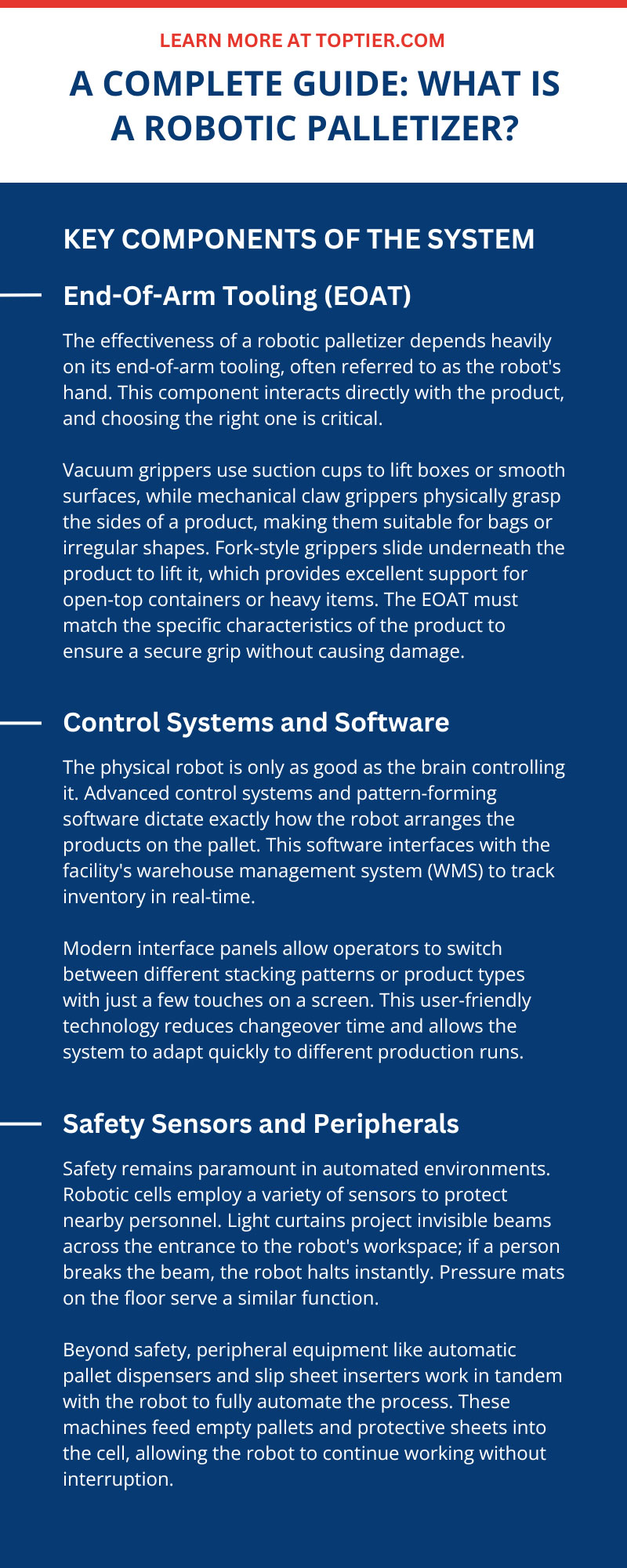
Key Components of the System End-Of-Arm Tooling (EOAT)The effectiveness of a robotic palletizer depends heavily on its end-of-arm tooling, often referred to as the robot's hand. This component interacts directly with the product, and choosing the right one is critical.
Vacuum grippers use suction cups to lift boxes or smooth surfaces, while mechanical claw grippers physically grasp the sides of a product, making them suitable for bags or irregular shapes. Fork-style grippers slide underneath the product to lift it, which provides excellent support for open-top containers or heavy items. The EOAT must match the specific characteristics of the product to ensure a secure grip without causing damage.
Control Systems and SoftwareThe physical robot is only as good as the brain controlling it. Advanced control systems and pattern-forming software dictate exactly how the robot arranges the products on the pallet. This software interfaces with the facility's warehouse management system (WMS) to track inventory in real-time.
Modern interface panels allow operators to switch between different stacking patterns or product types with just a few touches on a screen. This user-friendly technology reduces changeover time and allows the system to adapt quickly to different production runs.
Safety Sensors and PeripheralsSafety remains paramount in automated environments. Robotic cells employ a variety of sensors to protect nearby personnel. Light curtains project invisible beams across the entrance to the robot's workspace; if a person breaks the beam, the robot halts instantly. Pressure mats on the floor serve a similar function.
Beyond safety, peripheral equipment like automatic pallet dispensers and slip sheet inserters work in tandem with the robot to fully automate the process. These machines feed empty pallets and protective sheets into the cell, allowing the robot to continue working without interruption.
Elevating Your Business With AutomationRobotic palletizers are a mature, reliable technology that offers a clear path to modernization for warehouses and production plants. By shifting the burden of heavy lifting from humans to machines, businesses gain efficiency, safety, and consistency. These systems are not just about replacing labor; they are about optimizing the entire supply chain to meet the demands of a competitive market.
If you are ready to modernize your operations, TopTier offers advanced solutions tailored to your needs. Our hybrid robotic palletizing systems combine the flexibility of robotics with the reliability of traditional layer-forming technology. This approach ensures your business remains productive and competitive in an evolving marketplace. By applying the knowledge found in this complete guide to robotic palletizers, you can make the best strategic decisions for your facility. Contact us to learn how we can enhance your automated palletizing operations and help you build a more resilient future.