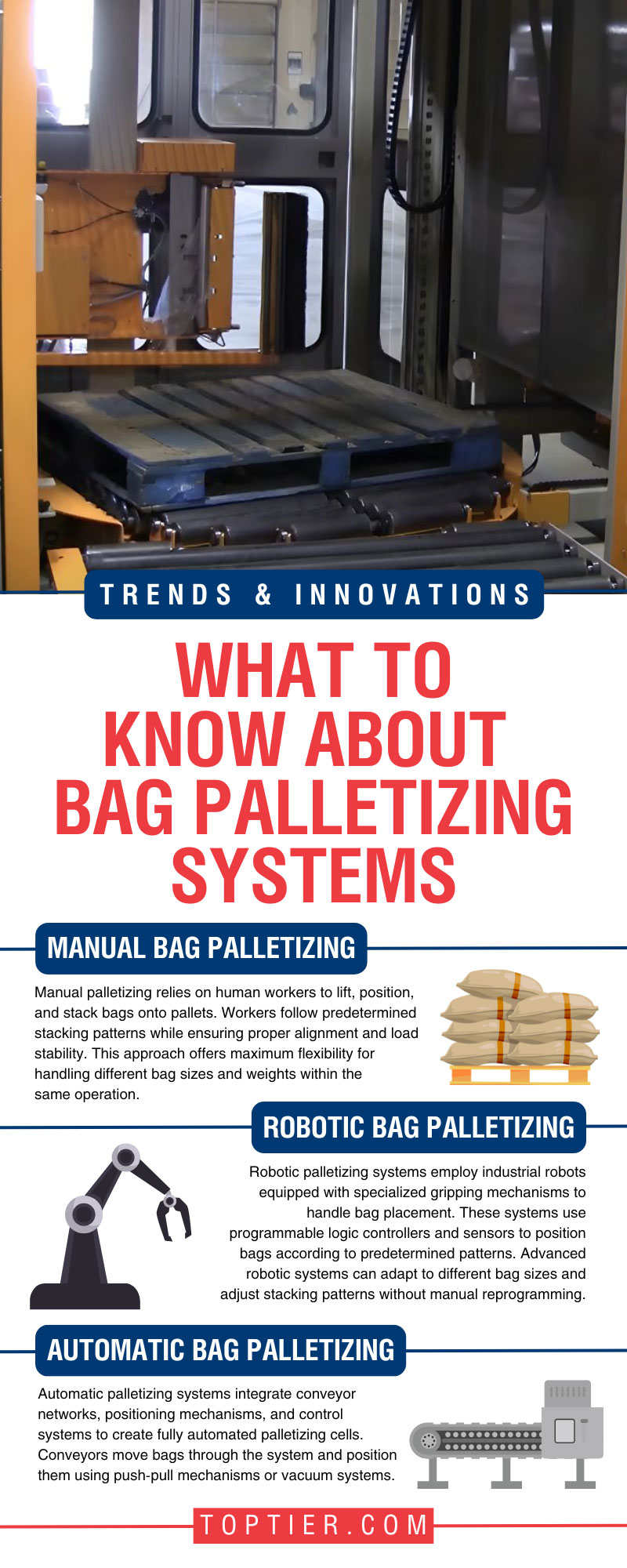
Manufacturing facilities and distribution centers handle thousands of bags daily for everything from pet food and fertilizer to cement and chemicals. The process of stacking these bags onto pallets for storage and shipping has evolved dramatically from purely manual labor to sophisticated automated systems. Understanding the different bag palletizing systems available can help businesses improve efficiency, reduce operating expenses, and create safer working environments.
What Is Bag Palletizing?Bag palletizing refers to the systematic process of arranging and stacking filled bags onto pallets in predetermined patterns. This process stabilizes loads, allowing you to safely transport, store, and handle them throughout the supply chain. The arrangement follows specific patterns that maximize space utilization while maintaining structural integrity during movement and storage.
The palletizing process involves several key considerations beyond simply stacking bags. Load stability depends on factors such as bag size, weight distribution, stacking pattern, and the friction between bag surfaces. Proper palletizing also accounts for pallet dimensions, maximum load heights, and transportation requirements.
Effective bag palletizing creates uniform, stable loads that resist shifting during transport. The process typically involves rotating bags in alternating layers, creating interlocking patterns that distribute weight evenly across the pallet surface. This methodical approach prevents load collapse and reduces product damage during handling.
Types of Bag Palletizing SystemsThere are currently three main systems for modern business owners to choose from.
Manual Bag PalletizingManual palletizing relies on human workers to lift, position, and stack bags onto pallets. Workers follow predetermined stacking patterns while ensuring proper alignment and load stability. This approach offers maximum flexibility for handling different bag sizes and weights within the same operation.
Manual systems work well for operations with lower throughput requirements or facilities that handle diverse product lines with varying packaging specifications. The human element allows for real-time adjustments and quality control decisions that automated systems might struggle to accommodate.
However, manual palletizing presents significant challenges. Worker fatigue becomes a concern when handling heavy bags repeatedly throughout each shift. Ergonomic injuries are common, particularly back strain and shoulder problems from repetitive lifting motions. Consistency can vary between different workers and throughout individual shifts as fatigue sets in.
Robotic Bag PalletizingRobotic palletizing systems employ industrial robots equipped with specialized gripping mechanisms to handle bag placement. These systems use programmable logic controllers and sensors to position bags according to predetermined patterns. Advanced robotic systems can adapt to different bag sizes and adjust stacking patterns without manual reprogramming.
Modern robotic palletizers incorporate vision systems that help identify bag orientation and positioning. These sensors enable robots to make real-time adjustments for bags that arrive slightly off-center or at incorrect angles. The flexibility of robotic systems makes them suitable for facilities that process multiple product lines.
Robotic systems excel in environments where precision and consistency are critical. They maintain the same stacking pattern and placement accuracy throughout entire shifts without fatigue-related performance degradation. Programming capabilities allow for quick changeovers between different products and stacking configurations.
Automatic Bag PalletizingAutomatic palletizing systems integrate conveyor networks, positioning mechanisms, and control systems to create fully automated palletizing cells. Conveyors move bags through the system and position them using push-pull mechanisms or vacuum systems.
Automatic systems typically include pallet dispensers, layer pad applicators, and stretch wrapping integration. These comprehensive solutions handle the entire palletizing process from empty pallet placement through final load wrapping and removal.
High-speed operations can palletize hundreds of bags per hour with consistent patterns and positioning accuracy. Integration with upstream packaging equipment creates seamless production lines that minimize handling between processes.
Benefits of Bag Palletizing SystemsImplementing proper bag palletizing systems delivers significant improvements that impact multiple operational areas.
Labor Cost ReductionLabor cost reduction represents one of the most immediate benefits, particularly for facilities currently relying on manual palletizing. Automated systems reduce the number of workers required while eliminating overtime costs associated with meeting production demands.
Greater ConsistencyImprovements in consistency affect both productivity and quality outcomes. Automated systems create uniform load patterns that optimize space utilization in storage areas and transportation vehicles. This consistency reduces product damage during handling and creates more predictable load characteristics for downstream operations.
Safety EnhancementsSafety enhancements provide both immediate and long-term value. Reducing manual lifting requirements decreases workplace injury rates and associated workers’ compensation costs. Automated systems also eliminate the safety risks associated with workers operating in close proximity to heavy machinery and moving pallets.
Higher ThroughputThe throughput capabilities of automated systems typically exceed manual operations by significant margins. Higher processing speeds enable facilities to meet increased demand without proportional increases in labor costs. This scalability becomes particularly valuable during peak production periods or seasonal demand fluctuations.
Applications of Bag Palletizing SystemsBag palletizing systems serve diverse industries with varying requirements and challenges.
AgricultureThe agriculture sector relies heavily on these systems for handling feed, seed, and fertilizer products. These applications often involve heavy bags and high-volume processing that benefit significantly from automation.
Building MaterialsThe building materials industry uses palletizing systems for products such as cement, lime, and various chemical compounds. These applications frequently involve bags with challenging handling characteristics, such as dusty surfaces or irregular shapes that require specialized gripping solutions.
Food ProcessingFood processing facilities utilize bag palletizing for products ranging from flour and sugar to pet food and animal feed. These applications must meet strict hygiene requirements while maintaining high throughput rates. Stainless steel construction and sanitary design features are critical considerations for food-grade applications.
Consumer GoodsConsumer goods manufacturers employ palletizing systems for products such as mulch, ice melt, and various packaged goods. These applications often require flexibility to handle seasonal products and varying bag sizes within the same production environment.
Factors To Consider When Choosing a Bag Palletizing SystemSelecting the appropriate bag palletizing system takes careful consideration of multiple operational factors.
Production VolumeProduction volume represents a fundamental consideration that influences the level of automation justified for the application. Facilities with consistent high-volume requirements typically benefit from more sophisticated automated systems.
Bag CharacteristicsBag characteristics significantly impact system design requirements. Weight, size, surface texture, and stability all influence the choice of handling mechanisms and system configuration. Bags with challenging handling characteristics may require specialized gripping solutions or modified stacking patterns.
Floor SpaceAvailable floor space constrains system design options and influences the choice between different automation approaches. Robotic systems often require less floor space than conventional automatic systems while providing similar throughput capabilities.
Integration RequirementsIntegration requirements with existing equipment affect system complexity and implementation costs. Facilities with established packaging lines may need custom interfaces and control system integration to achieve seamless operation.
BudgetBudget considerations encompass both initial capital investment and ongoing operational costs. While automated systems require higher upfront investments, they typically provide favorable returns through reduced labor costs and improved productivity.
Implementing a successful bag palletizing system requires careful planning and realistic expectations. Working with the experienced system integrators at TopTier ensures proper design and installation of your bag palletizing system while minimizing implementation risks. Our hybrid robotic palletizing systems will transform your packaging operations while delivering measurable returns on investment.